

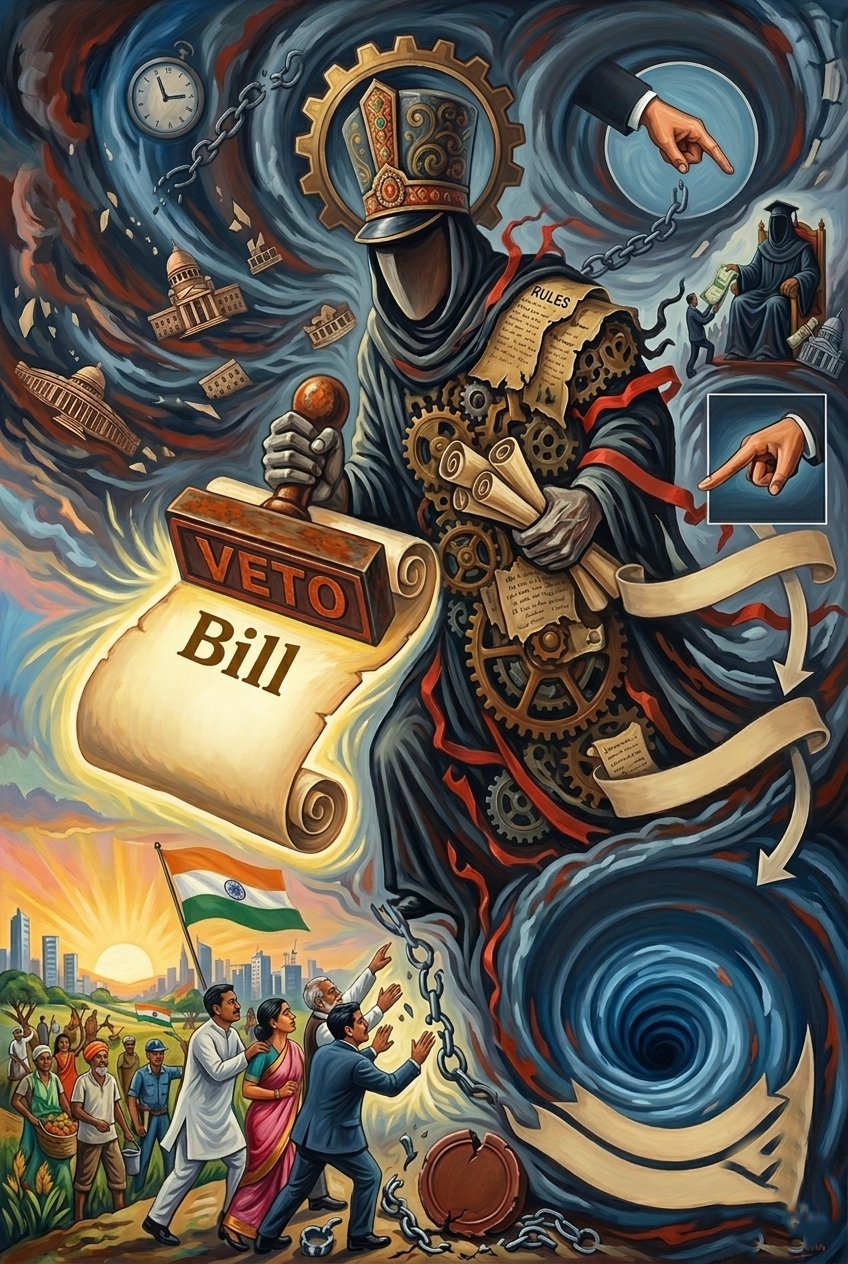
By Judgment dated April 8, 2025, in State of Tamil Nadu v. Governor of Tamil Nadu, W.P.(C) No. 1239 of 2023, the Supreme Court had put a definitive end to the unsavoury chapter of gubernatorial veto of the popular will.
The question was, what happens when the Governor of a State, when asked to assent to a Bill passed by the state legislature, does not exercise any of the three constitutional options, namely, assenting, withholding assent, or reserving the Bill for Presidential consideration, and just sits on it indefinitely, thereby exercising a pocket veto of sorts?
In such a situation, is the Supreme Court, the foremost guardian and enforcer-in-chief of the Constitution, powerless? The Apex Court answered in the negative and imposed definitive timelines for the Governors to act on the Bill, and further ruled that a breach of the timelines thus set could invite judicial intervention by way of a writ of mandamus.
In a well-reasoned judgment, the Court stipulated that if the assent to a Bill was to be withheld, or the Bill was to be reserved for the consideration of the President, upon the aid and advice of the State Council of Ministers, the Governor was expected to act on the advice immediately, “subject to a maximum period of one-month”, whereas if the withholding of the assent was against the aid and advice of the Council, the Governor had three months to return the Bill “with a message”; and if the Bill was to be reserved for the consideration of the President against the aid and advice of the Council, the Governor had “a maximum period of three months”. However, if the Bill, having been returned by the Governor in the first instance, was passed again after reconsideration by the Legislature with or without amendments, the assent was to be granted within the maximum period of one month.
However, there may be a situation where a bill referred by the Governor to the Legislature for reconsideration comes back with such amendments as to require presidential consideration, in which case the bill is likely to come with the advice for the Governor to reserve it for the consideration of the President, which, by natural corollary, gives the Governor one month. In case such advice is not extended by the Legislature, the Governor gets three months to refer it to the President, again, by natural corollary.
What if the bill returned to the Legislature for reconsideration is resent without any amendment at all? Naturally, the Constitution requires immediate assent by the Governor in that case, meaning the Governor got a month to sign the Bill into law, if the underlying rationale of the judgment is to be followed.
The rationale behind the timelines was also exceedingly simple. The Governor is neither a super-legislature nor a constitutional court, and cannot go either into the merits and demerits of the law, or into the constitutionality of it, and, therefore, does not need months on end to pick one of the options available under Article 200.
A bill passed a second time by the Legislature after being returned by the Governor for reconsideration is required to be necessarily granted assent by the Governor under Article 200, with the provision categorically barring the Governor from withholding assent a second time (“shall not withhold assent”).
Fully conscious of its role under the Constitution to protect the letter and spirit of the Constitution, the Supreme Court, in State of Tamil Nadu v. Governor of Tamil Nadu, clamped shut the constitutional loophole that allowed unelected Governors to stymie the enactments passed by democratically elected legislatures in brazen violation of the democratic principles enshrined in the text of the Constitution.
The Court also laid down that where the President fails to act on the Bills presented to them for assent under Article 201 within the prescribed period of three months, it was open for the State in question to seek a writ of mandamus from the Supreme Court against such inaction.
Leaving no wriggle room, the Supreme Court also invoked the concept of “deemed assent”, and in exercise of its extraordinary powers under Article 142, declared the ten Bills in question as “deemed to have been assented on the date when they were presented to the Governor after being reconsidered by the State legislature”, thus requiring no further action on the part of any constitutional authority to become law, except notification.
The Union Government, rather than preferring an appeal against the judgment, took the unusual step of invoking, through the President, the Advisory Jurisdiction of the Supreme Court in a Presidential Reference.
Special Reference No. 1 of 2025
The Supreme Court, answering the Presidential Reference in In re: Assent, Withholding or Reservation of Bills by the Governor and the President of India, Special Reference No. 1 of 2025, (decided on November 20, 2025), ruled that the judicial imposition of timelines had no textual foundation in the Constitution, and the discretion conferred upon the Governors and the President in respect of assenting to the Bills admitted of delays without rigid timelines, with the constitutional courts being powerless to lay down any. The Court categorically stated that “paragraphs 260-261 of the judgment in State of Tamil Nadu (supra), pertaining to the imposition of timelines on the Governor under Article 200 are erroneous” (Para 114).
Furthermore, rejecting the concept of “deemed assent”, the Court held that “the concept of ‘deemed assent’ in the context of Articles 200 and 201 presupposes that one constitutional authority (herein, the Court), could play a ‘substitutional role’ for another constitutional functionary (herein, the Governor, or President). Such a usurpation of the gubernatorial function of the Governor, and similarly of the President’s functions, is antithetical not only to the spirit of the Constitution, but also specifically, the doctrine of separation of powers which is a part of the basic structure” (Para 118).
The question now is: Having categorically referred to the Tamil Nadu judgment and having clearly rejected the view taken in the judgment in respect of the timelines and “deemed assent”, hasn’t the Supreme Court overturned the legal position settled by the Tamil Nadu judgment in exercise of its Advisory Jurisdiction in Special Reference No. 1 of 2025?
Judgment Overruled by the Advisory?
In an interview (The Hindu, November 24, 2025), former Chief Justice of India, Justice B.R. Gavai, said, “In a Presidential Reference, we cannot overrule a judgment, but we can lay down the law, and while laying down the law, we can observe that the law laid down in a particular manner is not correct.”
The view that sitting in a Presidential Reference, the Supreme Court “cannot” overrule a judgment appears erroneous in the light of the opinion expressed by a 7-judge Constitution Bench of the Supreme Court in In Re: Special Courts Bill 1978, wherein the court says, “We are inclined to the view that though it is always open to this Court to re-examine the question already decided by it and to overrule, if necessary, the view earlier taken by it, insofar as all other courts in the territory of India are concerned they ought to be bound by the view expressed by this Court even in the exercise of its advisory jurisdiction under Article 143(1) of the Constitution.”
What makes Justice Gavai’s statement even odder is that the 5-judge Bench headed by Justice Gavai himself, in Special Reference No. 1 of 2025, quotes the same, above-quoted portion in Para 19 and adds in Para 20: “We find that the reasoning of Chandrachud, J. (speaking for the majority) in the 7-judge bench decision of In Re: Special Courts Bill is compelling, insofar as it holds that our opinion may even go so far as to “overrule, if necessary”, the view taken earlier by this very Court. Pertinently, the Court in Natural Resources Allocation (supra), relying on the same paragraph (para 101) reiterated that this Court has the power to overrule a previous view.”
Clearly, a larger Constitution Bench has taken the view that it can indeed overrule a previous judgment, which opinion has been followed by another Constitution Bench in the Natural Resources Allocation reference (Special Reference No. 1 of 2012) and has been quoted with approval in the 2025 Reference itself, with both 2012 and 2025 Benches being of equal strength of five judges. Furthermore, in the Third Judges case (Special Reference No. 1 of 1998), an even larger Bench of nine judges did modify the composition of the Collegium established by the Second Judges case [Supreme Court Advocates-on-Record Association and Anr. v. Union of India, (1993) 4 SCC 441] from three judges to five, which is the current strength of the Supreme Court Collegium. It is a settled principle of the Doctrine of Precedent that a court that cannot overrule a judgment cannot modify it either, which is why the Special Reference No. 1 of 1998 was heard and decided by a nine-judge Bench, the Bench in the Second Judges case being of the same strength.
Doubtlessly, not only can the Supreme Court overrule its previous judgment in exercise of its Advisory Jurisdiction, but also where an opinion contrary to an earlier ruling of a smaller Bench or a co-equal Bench is expressed, it does, in fact, overrule the previous ruling without the Supreme Court having to expressly say that, because, as the Supreme Court said in the In Re: Special Courts Bill 1978, the opinion expressed by the Supreme Court even under Advisory Jurisdiction is binding on all courts across India.
Thus, the Tamil Nadu judgment, in view of the categorical pronouncements in the Advisory, stands overruled in key respects by necessary implication.
Can Advisory Review Settled Law?
Perhaps, Justice Gavai, in saying that the Supreme Court cannot overrule its previous judgments sitting in Advisory Jurisdiction, was referring to the nature of a Presidential Reference, and what it is not meant to do, which is to revisit, much less overturn, settled law.
The Advisory Jurisdiction of the Supreme Court is a mode of official dialogue between the head of the Executive, the President, and the Judicial branch of the State at the highest level, to enable the State to seek constitutional guidance before enacting a law, or taking such Executive action that might have to be later reversed by a constitutional court.
In short, Advisory Jurisdiction is a sandbox available to the State to test ideas of suspect constitutionality before a legislative enactment or an executive action invites judicial reversal, thus wasting a lot of time and resources of at least two, if not all three, branches of the State in the process.
Therefore, ideally, a Presidential Advisory seeking answers to the legal questions settled by the Supreme Court through an authoritative pronouncement should be declined, which the Supreme Court not only has all the power to do, but has also, in fact, done in Special Reference No. 1 of 1993.
The Apex Court can always be approached in an appeal against the judgment, or in review for reconsideration of the ruling, and also for clarification and modification, if the need be. Even the extraordinary, though limited, curative jurisdiction, specially created by the Supreme Court to prevent injustice, is also available in exceptional cases.
Furthermore, a settled legal issue may be reopened in a subsequent case and may then be differently settled. With all those options on the table, the route of invoking Advisory Jurisdiction to essentially appeal a judicial pronouncement ought to be foreclosed.
Besides, the option of appealing through Presidential References opens the possibility of there being another tier of appeal for the State, even after the very last remedy of Curative Petition has been exhausted, for the State can return with the same legal questions in a Presidential Reference, thereby effectively reopening the settled legal position.
However, when the State invokes the Advisory Jurisdiction before enacting a law, or taking such executive action as might be constitutionally questionable, it shortens the cycle of judicial determination of the constitutionality of an enactment or an executive measure, which is the real objective of Advisory Jurisdiction, in the first place.
For instance, before enacting the National Judicial Appointments Commission Act, 2014, and making the requisite constitutional amendments for the purpose, a Presidential Reference could have been made, which would have readily settled the constitutional standing of the move, thus avoiding the entire exercise of enacting a law and then having it set aside by the Supreme Court, thereby wasting a lot of time and resources.
The question is not whether the Supreme Court can or cannot reverse its ruling under Advisory Jurisdiction, but whether it should. It can just as well decline the advisory sought on the grounds that the questions sought to be answered have already been settled in a judicial pronouncement. And the Supreme Court in Special Reference No. 1 of 2012 did recognize that one of the grounds for refusal to answer a Presidential Reference is that “there is authoritative pronouncement of this Court which has already decided the question referred” (Para 60). And yet in Special Reference No. 1 of 2025, the Supreme Court did overrule an authoritative pronouncement that had indeed decided the question referred, and quite well.
Democracy v. Separation of Powers
In Special Reference No. 1 of 2025, the Supreme Court reasoned that the judicial stipulation of timelines for Governors and the President amounted to the judicial branch stepping into the domain of the executive branch, resulting in a breach of the Doctrine of Separation of Powers, which, the Court rightly pointed out, was part of the inviolable Basic Structure.
It seems the Court lost sight of democracy as another inviolable feature of the Basic Structure, not to mention Federalism. And the Governors in question were indubitably blocking the enactments passed by a democratically elected Legislature in accordance with the will of the people as the Constitution contemplates. Further, there is Separation of Powers between the Executive and the Legislature as well.
So, the question is, if democracy clashes with Separation of Powers, which feature must yield to which, both being part of the Basic Structure? Can we have Separation of Powers at the cost of democracy?
If the Preamble be looked at for guidance, democracy finds pride of place there, but Separation of Powers, not so much, simply because the latter is fundamentally a mechanism for the State to meaningfully strive towards the ideals outlined in the Preamble, such as Justice, Liberty, Equality and Fraternity, but as a polity India identifies as “sovereign, socialist, secular, democratic republic”, meaning being a “democratic republic” is a necessary component of India’s foundational identity.
Can we truly say democracy is second on any list of constitutional priorities? How is it that the Supreme Court, the chief protector of the Constitution, is asking democracy to yield to Separation of Powers, which is a mere tool to effectively serve and preserve India’s identity and ideals pithily encapsulated in the Preamble?
Besides, Separation of Powers has never meant strict compartmentalization of powers and functions, particularly in respect of the judicial branch of the state. Isn’t the Supreme Court empowered to declare the law under Article 141? Hasn’t the Supreme Court, on multiple occasions, framed placeholder laws to hold sway until the Legislature steps in to fill the legislative vacuum? Don’t constitutional courts regularly direct and supervise the functioning of the Executive in continuing mandamus? The fact is, constitutional courts have — thankfully — stepped in to save the day whenever either of the other two branches of the state has been found wanting. And that has been one of the most remarkable features of how India’s constitutional courts operate. So, citing Separation of Powers as a ground is not reasoning at all, not even bad reasoning; it’s offering an excuse, and a lame one.
In laying down the timelines, the Supreme Court had served the spirit of Article 200, and in reading the concept of “deemed assent” in the expression “shall not withhold assent”, the Court had given full play to the import of the letter in the service of the spirit.
What if the Governor or the President refuses to grant assent despite the “shall not withhold” in Article 200 and Article 111, or despite an order by the Supreme Court? Would somebody somehow forcibly make them sign the instrument of assent? Shouldn’t the assent then be deemed to have been granted rather than — at the risk of sounding ridiculous — exercising physical force on the Governor or President? Or do we want to remove the unwilling functionary and replace them with a willing one, and then obtain the assent?
The constitutional courts are supposed to plug the gaps in the letter of the Constitution in the service of its spirit, should the well-meaning gaps deliberately and thoughtfully left by the framers of the Constitution be abused to subvert constitutional values? The Constitution does not contemplate the highest court of the land being powerless to protect, defend, and enforce the Constitution, which is why the Supreme Court has been vested with plenary powers under Article 142.
In effectively reversing the legal position settled by the Tamil Nadu Judgment in Special Reference No. 1 of 2025, the Supreme Court restored the chaos of unbridled discretion, and thus failed the spirit of the Constitution, if not the letter, strictly speaking.
The Governors can now go back to over-governing, and the States back to challenging it before the Supreme Court, seeking limited mandamus, which remedy has not been taken away yet.
Originally published as Cover Story in Lawyers Update, March 2026 Issue (Vol. XXXII, Part 3).